

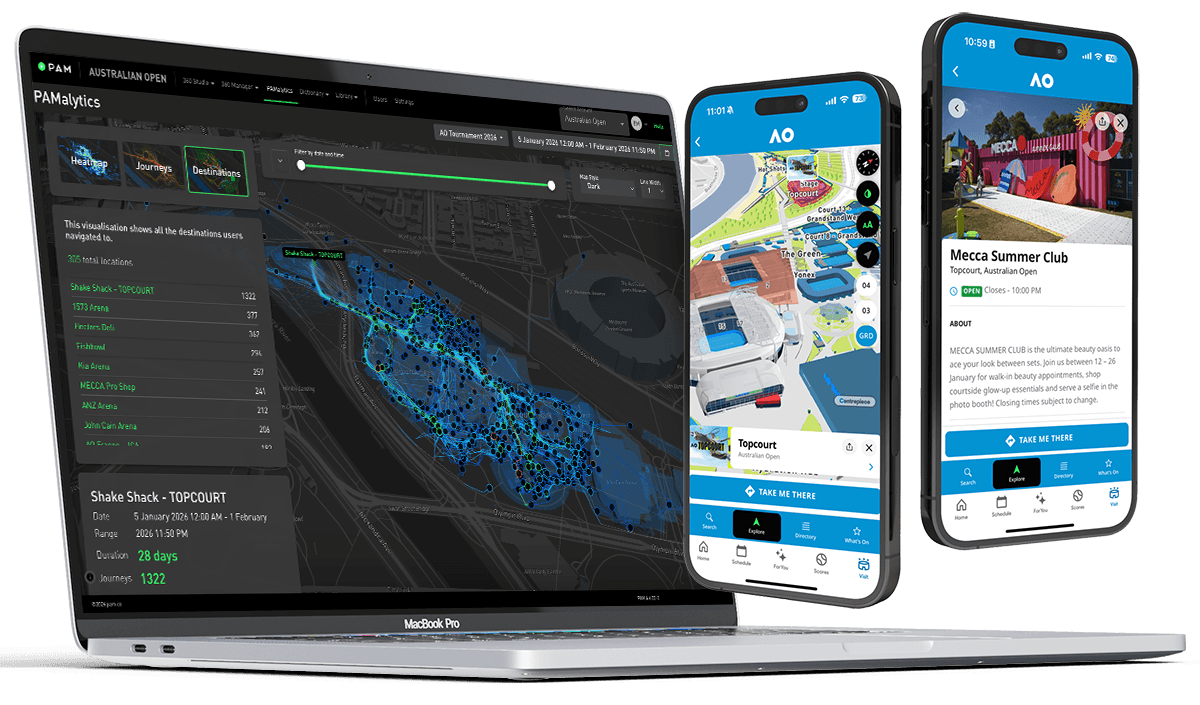
A SmartMap is an interactive digital map of an event or venue that opens in a phone browser from a link or a QR code, with no app to install. It shows the site as it is today, searches every place a fan might want, gives a route there, and changes when the organiser changes the layout.
PAM (People And Movement) is a digital wayfinding platform for premium events and venues. Its SmartMaps give fans outdoor and indoor mapping across city-scale events, stadiums and campuses. This page explains what a SmartMap does and compares it with the three things organisers most often use instead: an event app, a PDF map and Google Maps. The figures are from our published customer case studies.
What does a SmartMap do that an ordinary map does not?
- It opens without an app. A fan scans a QR code or taps a link in a ticket email and the map is there.
- It shows this event. Grandstands, gates, fan zones, hospitality and closures are drawn for this edition, not last year’s.
- It searches. A fan types a seat section, a food stand or a sponsor’s name and gets a result.
- It routes. The map draws the walk from where the fan is to where they want to go, using the entrances that are open.
- It changes. The organiser switches the whole map from one prepared layout to another, or closes a single gate, and every fan sees it.
- It carries sponsors. Sponsored places and featured links sit inside the map and are counted click by click.
- It reports. Searches and routes show what fans looked for and where they went.
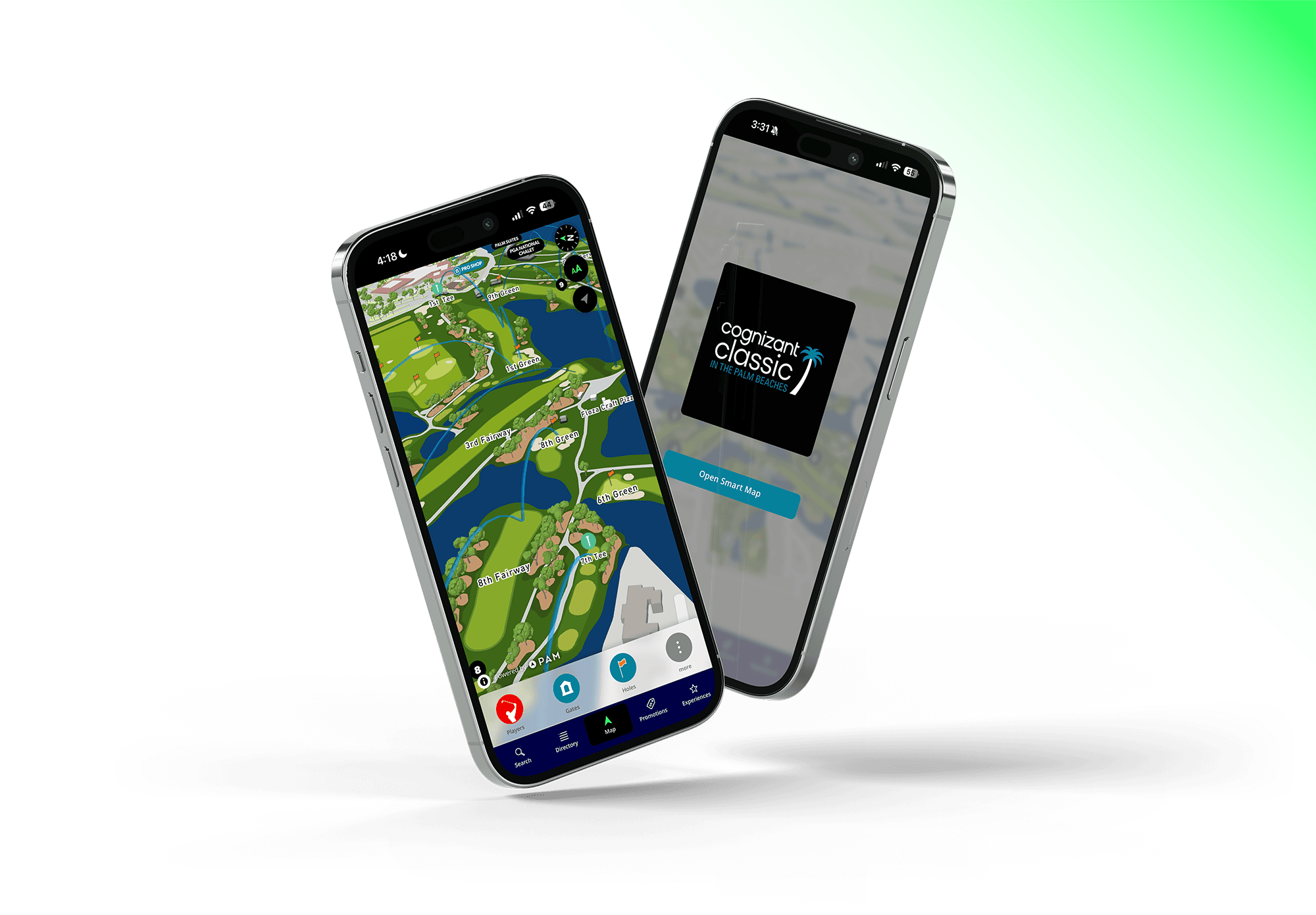
The same map can run in more than one place at once: in the browser, inside an official app, on a kiosk and on screens around the site. More detail is on the SmartMaps product page, and the background is in the invisible technology behind interactive venue maps.
How does a SmartMap compare with an event app, a PDF map and Google Maps?
Question | SmartMap | Event app | PDF map | Google Maps |
|---|---|---|---|---|
How does a fan get it? | A link or QR code, in the browser | Download from an app store | A download, or printed | Already on most phones |
Does it show this event’s temporary layout? | Yes, drawn for each edition | Only if a map is built into it | Yes, as a fixed picture | Generally not |
Can a fan search and get a route inside the site? | Yes | Depends on the map inside it | No | To the address, rarely beyond the gate |
Can the organiser change it during the event? | Yes, in real time | Often needs a new release | No, it has to be reissued | Not under the organiser’s control |
Can sponsors appear and be measured? | Yes, per click | Yes, as banners or pages | A logo only | Not by the organiser |
What does the organiser learn afterwards? | Searches, routes and clicks | App analytics | Nothing | Nothing |
The table describes the usual case. A well-funded event app with a good map inside it can do most of what the first column does. The practical question is how many fans will ever install it.
SmartMap or event app: which does a major event need?
Often both, and they are not rivals. An app holds tickets, schedules, video and accounts. A map is one service. The mistake is to put the map only inside the app, where the fans who never download it cannot reach it.
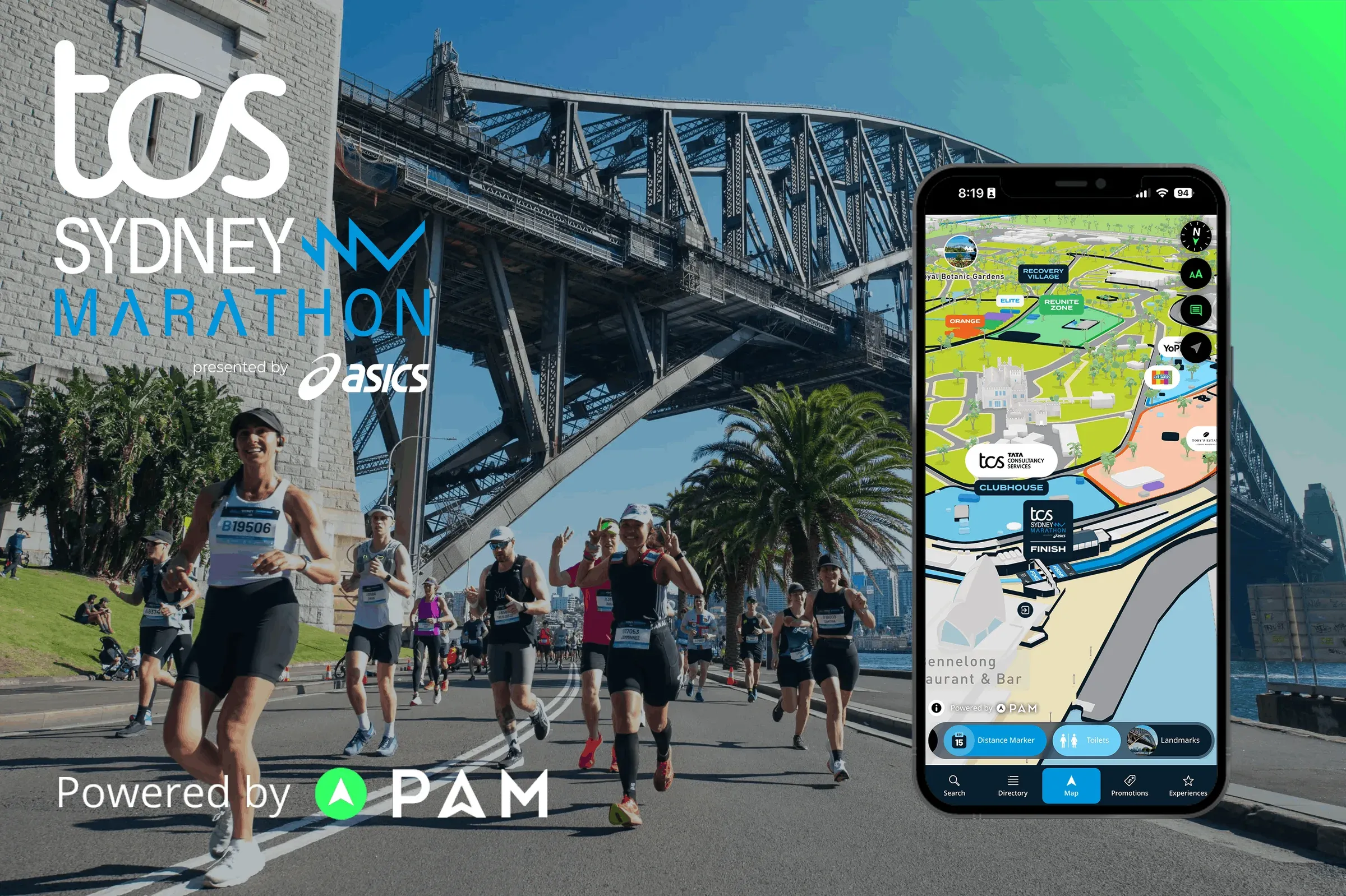
At the 2023 Las Vegas Grand Prix, the map ran inside the official app and on the website. One in three of the 315,000 fans used it, and 91,500 unique users made 412,000 searches. See the Las Vegas Grand Prix case study.
QR codes matter more than they look. At the Australian Open in 2024, more than 10,000 QR scans around the precinct led to 14,000 journeys. Those are fans who opened the map at the moment they were lost, with nothing installed. See the Australian Open case study.
Why not just publish a PDF map?
A PDF is quick, cheap and worth having for print. As the main map for a large event it has four limits. It cannot be searched, so a fan has to find a small label on a large picture. It cannot give a route. It cannot change when a gate closes. And it tells the organiser nothing about what fans were looking for.
The last point is the least obvious cost. At the Australian Open in 2024, 87,000 unique users made 109,000 searches in the map. Each search is a fan saying what they wanted, which a PDF never records. We cover this in what your map data is telling you.
Why not rely on Google Maps?
Fans will use it anyway, and they should. A general-purpose map is very good at getting someone across a city to an address. A SmartMap picks up where that stops.
- Temporary structures. A grandstand built for one week is generally not on an everyday map.
- The right entrance. A general map routes to a place. An event map routes to the gate that matches the ticket and is open now.
- Inside the perimeter. Seat sections, hospitality suites, food stands and first aid are the organiser’s information.
- Control. When the organiser closes a route, their own map changes at once.
The two work together. At the 2023 Las Vegas Grand Prix, fans made 108,000 journeys with the event map, some starting miles from the circuit.
What can an organiser change on the day?
A SmartMap holds prepared layouts, which we call scenes. Each scene is a complete version of the site: which gates are open, where the crowd should walk, what is on sale. Switching scene changes the map for everyone.
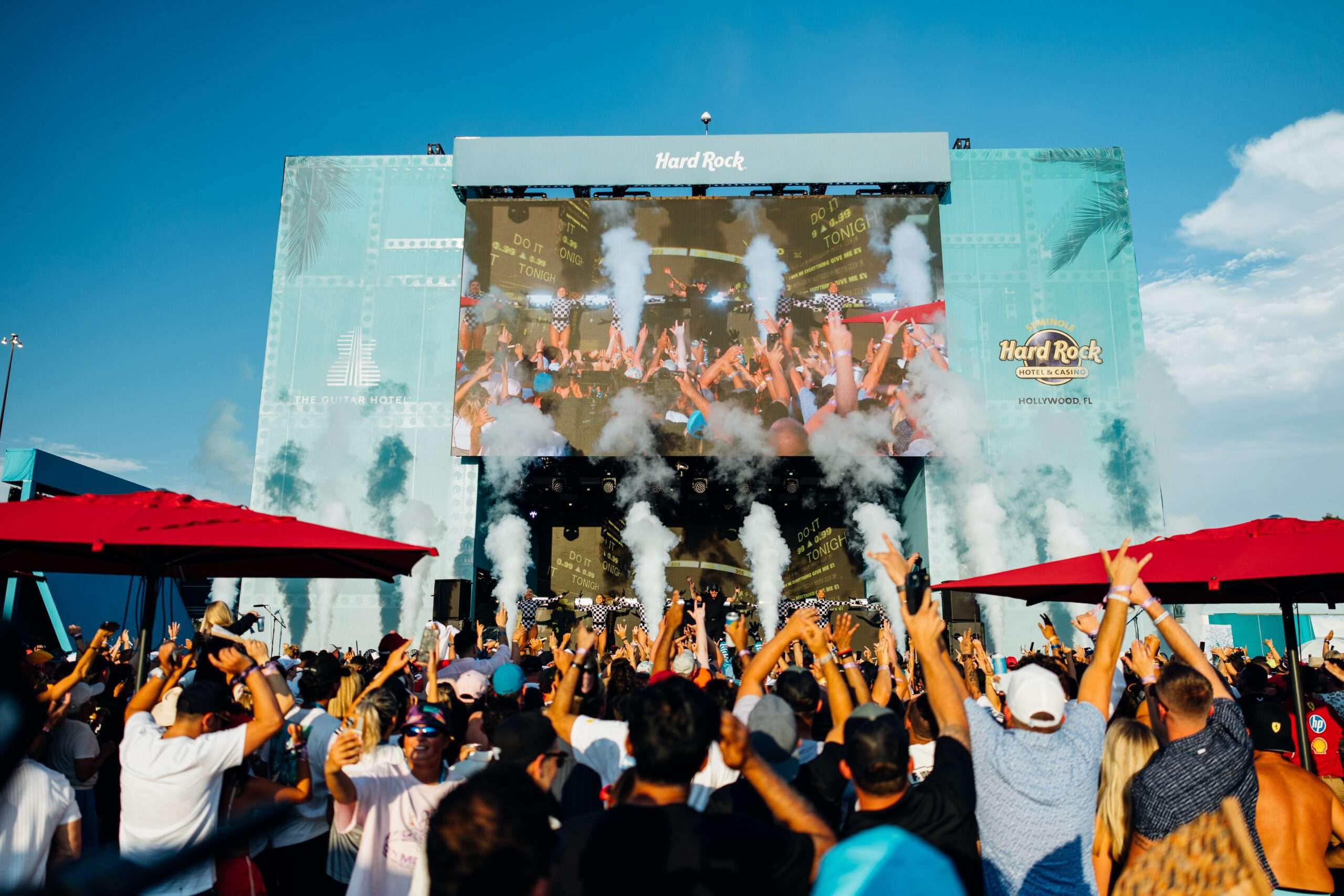
- Whole-site changes. Hard Rock Stadium in Miami switches from game day to concert mode in one action. See the Hard Rock Stadium case study and managing a venue’s changing identity.
- Changes across a multi-day event. In Las Vegas in 2023, scenes carried crowd-flow changes across five days.
- Single changes. A gate or a point of interest can be updated in real time, and the change reaches the phone map, kiosks and signs together.
- No waiting. The venue team makes the change themselves. See why a venue should own its map.
How do sponsors appear in a SmartMap?
As places and links a fan can act on. A fan looking for a drink can be shown a sponsor’s bar and a route to it. Every click is counted, so a sponsor gets a number, not an impression estimate. The formats are set out in three SmartMap revenue streams.
At the 2025 Truist Championship, sponsored placements in the map drew a 32% click-through rate, against a 0.5% benchmark for display advertising. That is one event, and an in-map placement is not a like-for-like comparison with a banner. See the Truist Championship case study. The commercial layer is described on the SmartSponsors page.
Frequently asked questions
Do fans need to download anything to use a SmartMap?
No. It opens in the phone’s browser from a QR code or a link in a ticket email, on the event website or in a message. Fans who already have the event’s app can open the same map inside it.
Can a SmartMap sit inside our existing app?
Yes. At the 2023 Las Vegas Grand Prix it ran inside the official app and on the website at the same time. Fans with the app and fans without it used the same map, and one in three of 315,000 fans used it.
Does a SmartMap work indoors as well as outdoors?
Yes. One map covers the outdoor precinct and the buildings inside it, such as concourses, halls and campus buildings. That matters at events where a fan walks from a station, across a park and into an arena in a single journey.
Who updates the map during an event?
The organiser’s own team. Layouts are prepared in advance as scenes, and staff switch between them or change single points as the day unfolds. Hard Rock Stadium changes its whole venue from game day to concert mode in one action.
Is a SmartMap only for events?
No. The same platform runs permanent venues. At the University of Technology Sydney it has guided 46,000 students, with more than 8,000 signs across more than 20 buildings. The wider subject is covered in what is digital wayfinding. Our approach to events is on the wayfinding for major events page.